Laguna Encantada
On Barú, the Rosario Islands, and what happens after dark.
Forty-five minutes from Cartagena, the crossing ends and something else begins.
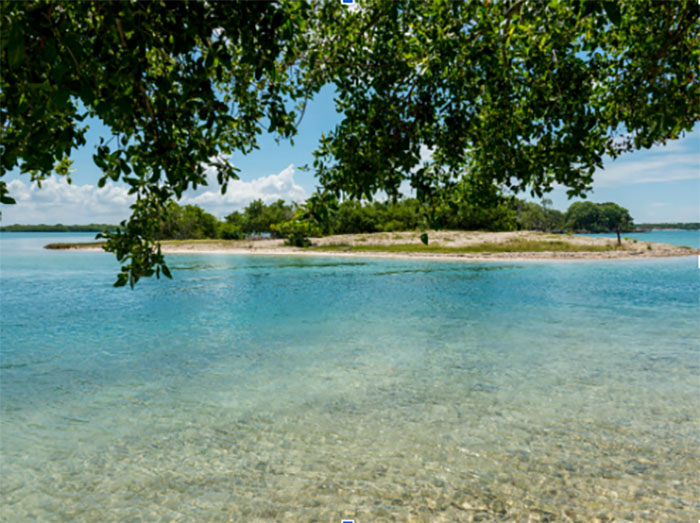
The water changes color first — from the darker blue of the open bay to a turquoise so specific it seems artificial, until you realize it is simply shallow and clear and alive with what lives below it. Then the islands appear: low, green, unhurried, spread across a protected marine national park that covers 120,000 hectares — the most extensive coral platform on the continental Caribbean coast. Twenty-eight islands in total, some small enough to walk across in minutes, others dense with forest and mangrove and the accumulated life of centuries.
Colombia is the second most biodiverse country on earth. What the Rosario Islands and Barú hold is a concentrated argument for why.
The islands were inhabited long before Cartagena existed. The Karib people — the indigenous civilization whose name, in its various forms, gave the Caribbean Sea its name — navigated and settled these waters for centuries before European contact. Later, during the colonial era, the narrow channels between islands became shelter for those who needed to disappear: pirates who preyed on the galleons of the Flota de Indias, and cimarrones — those who had escaped slavery and built their own lives in the margins of the colonial world.
What survived all of that is Orika — the Afro-descendant community that has lived on Isla Grande for generations. Today Orika is a community of fishermen who know this reef the way others know their neighborhood. They run the island’s community tourism project, with a Museum of Living Memory where knowledge of the sea, the mangroves, and the history of this particular piece of Colombian coast is passed from elder to younger.
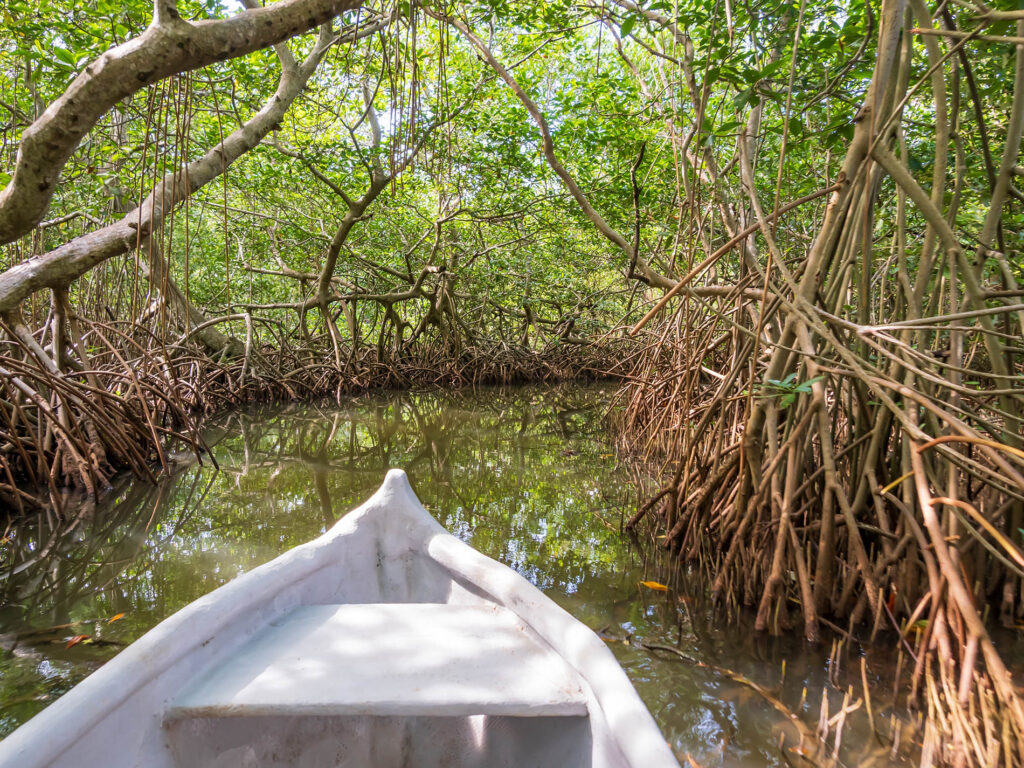
Isla Barú holds some of the most extensive mangrove lagoons on the Colombian Caribbean coast. Red mangrove, black mangrove, white mangrove, and buttonwood grow in dense formations along the lagoon’s edge, their root systems creating the specific conditions — still water, high oxygen, shallow depth — that support an extraordinary density of life.
The wildlife here is not shy. Raccoons appear at the water’s edge and at the sides of boats that move through the mangrove channels — curious, unhurried, willing to take food directly from an outstretched hand. They come in groups. Iguanas occupy the rooftops and palm trunks of the island’s structures. Chachalacas call from the forest before dawn. Brown pelicans and magnificent frigatebirds work the channels throughout the day. The terrestrial world here is as layered as the marine one — which is something most visitors, focused on the water, never quite see.
Below the surface, the reef holds what Colombia’s biodiversity ranking suggests it should. Brain corals the size of boulders. Sea fans oriented perpendicular to the current. Hawksbill sea turtles, critically endangered and unmistakable, feeding on the sponges in the reef structure. Nurse sharks resting motionless under coral ledges. Pargo, barracuda, parrotfish, moray eels. Caribbean reef octopus that vanish into crevices and reappear, minutes later, exactly where you stopped looking.
The water is clear enough that the reef is visible from the surface — which means that what lives below is always present, even when you are not in it.
And then there is the night.
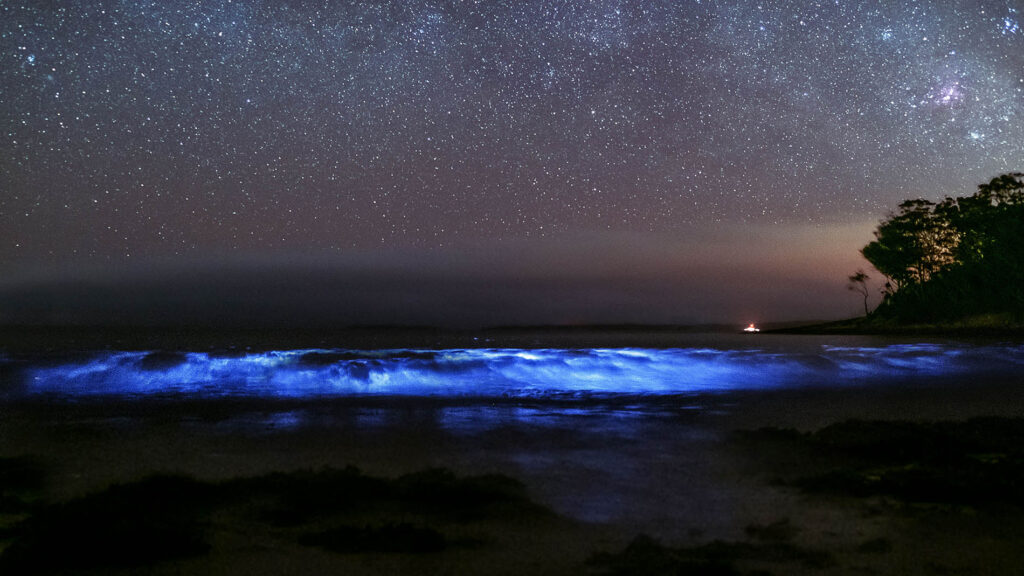
In the Laguna Encantada on Isla Grande, the water lights up. Noctiluca scintillans — known here as chispa de mar, sea spark — is a bioluminescent dinoflagellate that emits blue light when disturbed. The lagoon’s conditions — surrounded by mangroves, shallow, still — make the effect visible in a way that occurs in only a handful of places on earth. Move your hand through the water and it trails blue light. Swim and your whole body is outlined in it, like swimming through a sky full of stars that move with you. Pull your arm from the surface and watch the drops roll down your skin, each one briefly lit before it disappears.
The chispa de mar only reveals itself in darkness. When it appears, it is one of the most quietly extraordinary things a body of water can do. The islands are like that too. They do not announce themselves. They are simply there, doing what they have always done, in the particular way that only this stretch of Colombian Caribbean can do it. The ones who see it are the ones who stayed long enough, and went far enough, and turned the lights off.