What the Sea Kept
On shipwrecks, coral, and the underwater world five centuries of Caribbean history left behind.
Most people who visit Cartagena never look down.
They look up — at the colonial balconies spilling bougainvillea in colors that seem too vivid to be real, at the cathedral, the sky at golden hour. They look across — at the bay, the horizon, the silhouette of Tierra Bomba in the distance. The city earns that attention completely. Its historic center, its gastronomy, its Afro-Caribbean music and color — and above all its murallas, those colonial fortifications built over two centuries of stone and coral, declared a UNESCO World Heritage Site and still standing exactly where the Spanish left them. Cartagena above the waterline is one of the great cities of the Americas.
But the fishermen of Tierra Bomba and Bocachica — communities whose canoas still leave before dawn the same way they did a century ago — have always known that this coast has another dimension. They know where the fish run, where the current shifts, and what the seabed holds in places tourists never reach. That knowledge, passed from generation to generation on these waters, is one of the most local things Cartagena has. And most visitors leave without ever encountering it.
For nearly five centuries, Cartagena was the most fortified port in the Americas — the place through which the wealth of an entire continent passed on its way to Spain. Francis Drake sacked it in 1586. The English Admiral Edward Vernon arrived in 1741 with 186 ships and nearly 27,000 men — the largest fleet ever assembled in the Americas at that time — and left defeated eight weeks later, turned back by Cartagena’s murallas and its one-armed, one-eyed, one-legged admiral, Blas de Lezo, who became a legend precisely because he refused to fall. Every fleet that came here, friendly or hostile, had to navigate the same narrow channel past Bocachica. Not all of them made it through.
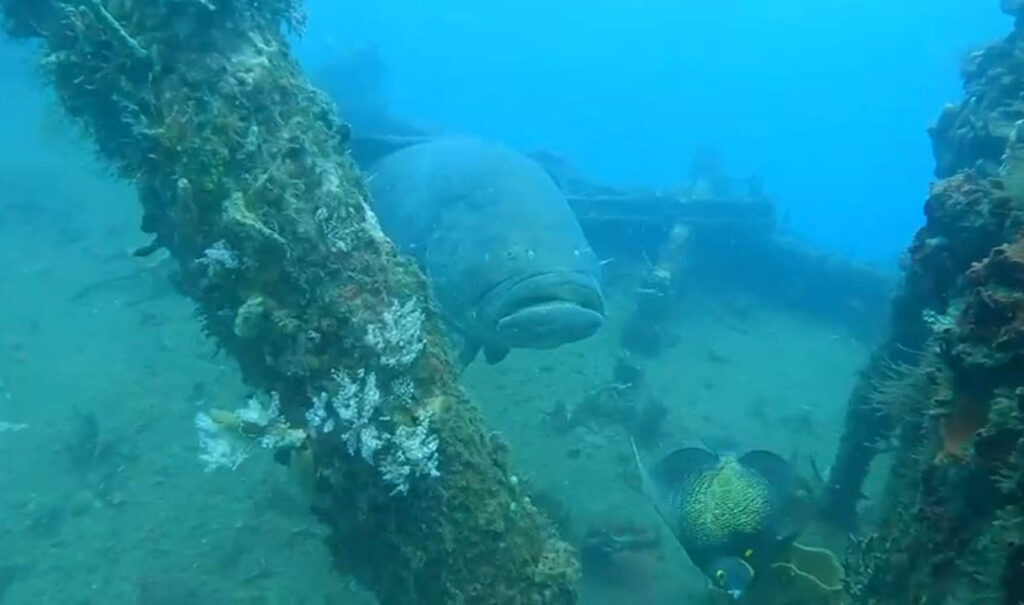
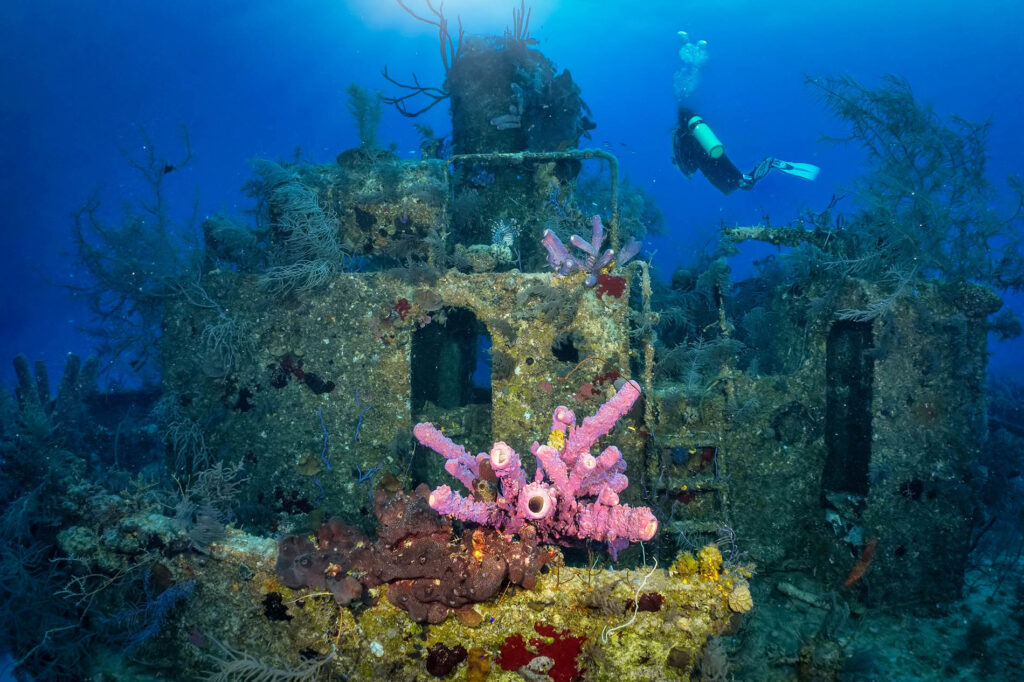
The vessels that rest on the seafloor near these waters span centuries and stories. Some date to the colonial era — timber frames and ballast stones long since claimed by coral, their origins legible only to those who study the seabed the way others study archives. Others are decades-old wrecks, more recent chapters in the same long history, that the Caribbean has transformed into something else entirely: artificial reefs dense with marine life, unrecognizable now as the vessels they once were. The sea does not preserve history. It converts it.
At the Salmedina Banks, a shallow reef system near the mouth of the bay, some of these wrecks rest at depths accessible to snorkelers and novice divers — no advanced certification required. The drama is not in the depth. It is in the realization, hovering above a coral formation that was once a hull, that you are reading a chapter of Cartagena’s history that no museum has catalogued.
Away from the wrecks, the reefs around Barú and the Rosario Islands — protected within the Corales del Rosario y San Bernardo National Natural Park — hold a different kind of underwater world. One defined not by history but by the specific, living richness of this stretch of Colombian Caribbean.
Hawksbill sea turtles, critically endangered and among the most striking creatures in the ocean, feed on the sponges embedded in these coral formations — their amber-patterned shells unmistakable against the blue. Nurse sharks rest motionless under coral ledges during the day, indifferent to the divers who pass above them. Eagle rays glide through when the current picks up, moving with the unhurried confidence of animals that have no predators here. In the sandy patches between reef structures, southern stingrays lie half-buried, visible only by their outline. Caribbean reef octopus disappear into crevices as you approach, then reappear when you stop moving.
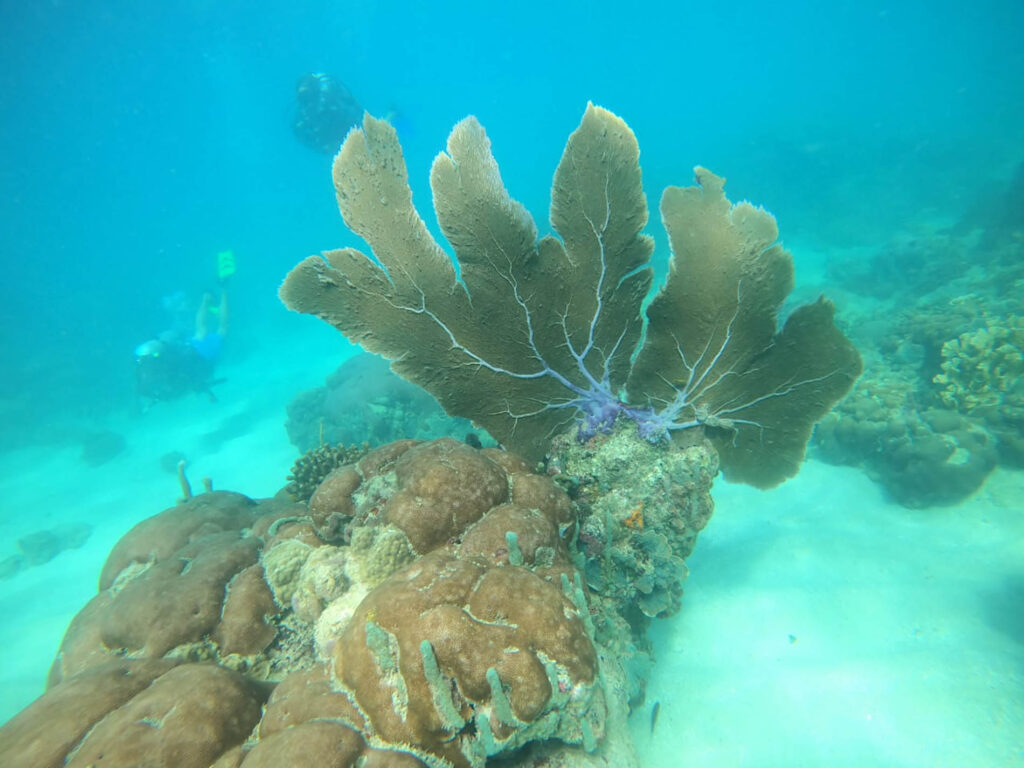
The coral itself rewards attention. Brain corals the size of boulders, their surfaces mapped with the same folded geometry for which they’re named. Plate corals stacked in formations that took decades to build. Sea fans swaying in the current — soft corals that orient themselves perpendicular to the water flow to catch what the sea brings them. This is a reef ecosystem that has been building itself, slowly and without interruption, since before the murallas of Cartagena were laid.
You surface into the same Caribbean that Drake crossed in 1586, that Vernon tried to take in 1741 and couldn’t. The murallas in the distance, exactly where Blas de Lezo held them. Below, the reef continues its slow, indifferent work. The city kept its history in stone. The sea kept its own version — in coral, in silence, in everything that sank and stayed.